7 October 2026
Open a Trust in the Cayman Islands
Opening a trust in the Cayman Islands can be make with the help of our company formation specialists who can assist you in any related issues.

The opening of a trust in the Cayman Islands can be tailored according to the requirements of estate planning, asset management, and investment strategies. There is an element of flexibility within the jurisdiction in the powers of trustees, the beneficiaries of a trust, and the requirements for the distribution of the assets of a trust. Our specialists can offer help in all the legal and administrative requirements of setting up and managing the Cayman Islands trusts.
| Quick Facts | |
|---|---|
| Relevant laws | The Trusts Act (as revised), including Part VIII on special trusts (STAR) |
Restrictions | No restrictions apply to the accumulation of income. |
Manner of setting up a trust in the Cayman Islands | Through a trust deed |
| Trust deed type | It can be drawn up to allow for fixed or discretionary interest. |
| Where is the trust registered | Only exempted trusts must be registered with the Registrar of Trusts (General Registry); ordinary trusts are not registered |
| Taxes on Cayman Islands trusts | Not applicable |
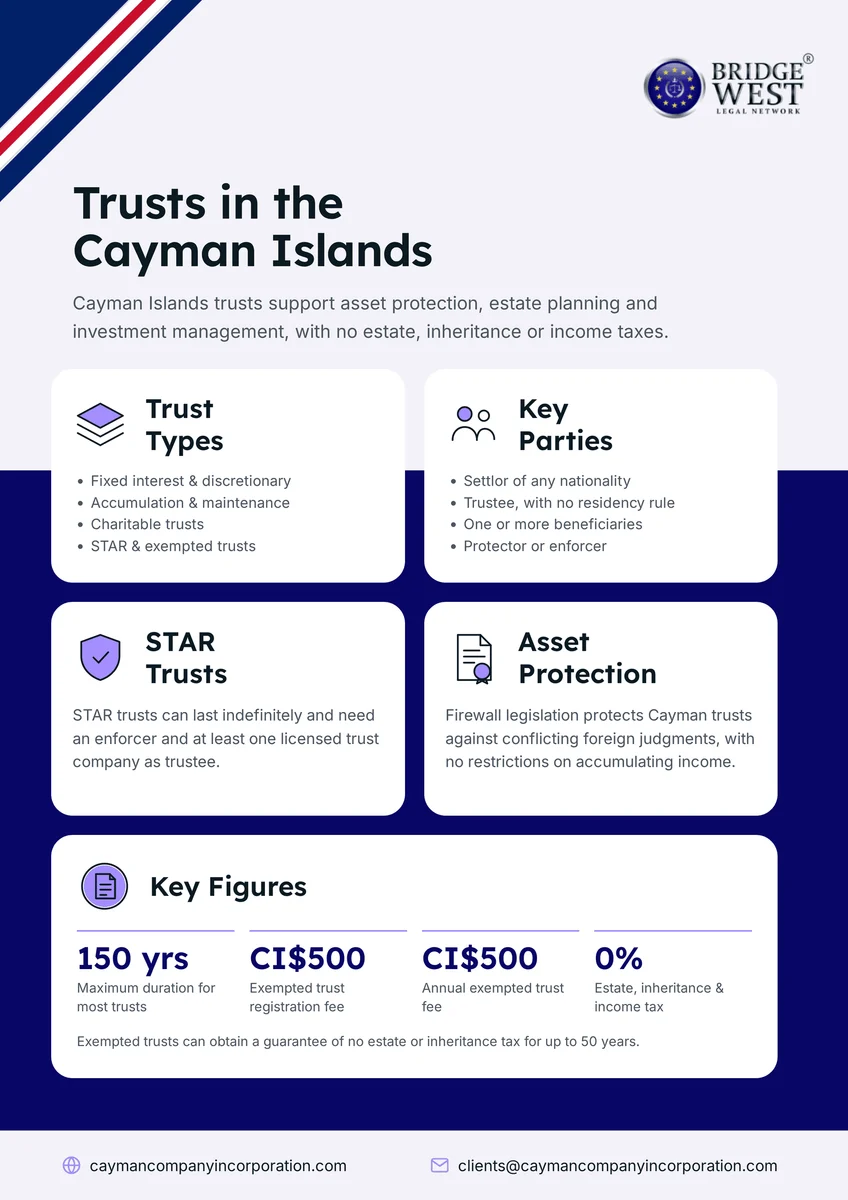
| Types of trusts | Exempted trusts, special trusts (under the Alternative Regime Law) |
| Trust registration fee | CI$ 500 |
| Trust annual fee in the Cayman Islands | CI$ 500 |
| Trust founders | The settlor (there are no restrictions on nationality), he/she can also be a beneficiary. |
| Settlor powers | In some cases, a settlor can also act as a co-trustee. |
| Trustee | The individual (or company) entrusted with administering the trust. |
| Trust beneficiaries | The individual(s) who will benefit from the assets included in the Cayman Islands trust. |
| Cayman Islands trust advantages | Highly flexible, exempt from the rules against perpetuities (in some cases), no taxes for trusts. |
| Assistance for trust creation | Our Cayman Islands company formation specialists provide complete assistance for the registration of trusts. |
| Purposes for a trust | – asset management, – estate planning, – wealth preservation, – commercial activities, etc. |
Trust components | – settlor, – trustee, – enforcer, – beneficiary, – trust fund |
Fixed trusts – characteristics | Beneficiaries receive income and capital according to predetermined terms; It is generally used for estate planning or pension management. |
| Accumulation and maintenance trusts – characteristics | Allow for savings to grow over time; Often used for children or grandchildren of beneficiaries and can be used to distribute funds for their education and needs. |
| Discretionary trusts – characteristics | Flexibility for both the settlor and beneficiaries; The trustee can decide over distributing income and capital among beneficiaries. |
| Charitable trusts – characteristics | Benefit charitable purposes rather than specific individuals; Are overseen by the Cayman Islands Attorney General; Can exist indefinitely. |
| STAR trusts – characteristics | Can exist indefinitely; Offer flexibility in their structure; Settlor must appoint an enforcer; Must have at least one trustee who holds a trust company license. |
| Trustees duties | Must act honestly and in good faith; Must comply with the trust deeds; Must maintain accurate records and accounts; Must comply with local regulations, etc. |
| Trust confidentiality | No public registration or disclosure obligations |
| Tax exemption guaranteed for exempted trusts | No estate or inheritance tax in Cayman for up to 50 years from trust creation |
| Commercial uses for trusts | – providing benefits to employees, – administering pension funds, – facilitating investment funds, – securing assets for lenders, etc. |
| The Cayman Islands “firewall” legislation | Trust assets in Cayman Island are protected by not accepting foreign judgments that go against Cayman law. |
| Cayman trusts maximum duration | 150 years, with the exception of charitable and STAR trusts |
| Trust name | Must be unique, identifiable, and reflective of its purpose |
| Additional services offered by our team | We can also help in opening a Cayman Islands exempted company or you can seek our immigration lawyers for relocation matters. |
What support is provided for opening a trust in the Cayman Islands?
We can help clients with the establishment of a Cayman Islands trust through the following services:
- choosing the right trust structure;
- drafting and reviewing trust documents;
- helping register the trust;
- providing guidance on selecting a trustee, beneficiaries, and protectors;
- other compliance issues;
- other services relating to Cayman Islands corporations.
What are the uses of a trust in the Cayman Islands in 2026?
As a legal vehicle, a trust has a simpler setup process, when compared to the general procedure for company formation in the Cayman Islands. Some of the common purposes of a trust include the following:
- asset management and protection;
- estate planning;
- the preservation of wealth;
- commercial uses.
Which are the parties of a Cayman Islands trust?
The parties to a Cayman Islands trust are the following:
- The settlor: the individual who creates the trust and owns the assets; he may retain a certain level of control;
- The trustee: the party invested with the power to administer the trust and distribute the assets according to the wishes of the settlor; there is no legal requirement for the trustee to be a Cayman Islands resident;
- The beneficiary: a trust can have one or more beneficiaries, the persons entitled to receive the funds of the trust.
What are the types of trusts in the Cayman Islands in 2026?
Before deciding to open a Cayman Islands trust, investors should understand the most common forms. Our team highlights these below:
- fixed interest trusts;
- accumulation and maintenance trust;
- discretionary trust;
- revocable trust;
- charitable trust;
- “STAR” trusts.
Find below more information on how to set up a trust in the Cayman Islands:

For what types of trusts in the Cayman Islands is available the Trusts Register?
The Cayman Islands General Registry keeps a Trusts Register for the following types of trusts:
- exempted trusts;
- special trusts under the Alternative Regime Law (STAR).
What information should be retained by the trustees?
The trustees must keep updated information related to the trust, namely:
- the trust deed and its terms;
- details about the trustee and the settlor;
- about the beneficiary;
- about the protector.
What are the advantages of opening a trust in the Cayman Islands in 2026?
Setting up a trust in the Cayman Islands could offer a useful vehicle to control your assets. Such a trust could be used, among other things, to:
- Protect assets using a different legal framework to hold the trust assets;
- Provide estate planning options by stipulating the distribution of assets;
- Manage wealth over time for families and beneficiaries;
- Have a flexible structure that enables you to allocate powers and responsibilities among trustees, protectors, etc.;
What are the compliance requirements for Cayman Islands trusts in 2026?
The trustees may have compliance obligations related to registration, record-keeping, and fees, as well as regulatory information, depending on the nature of the trust structure. Legislation in the Cayman Islands also contains requirements related to transparency and beneficial ownership.
What are the fees applicable for setting up a trust in the Cayman Islands?
Below, our team lists some of the most important fees applicable to a Cayman trust:
- CI$500 (approx. US$610) registration fee;
- annual trust fee of CI$500 (approx. US$610);
- CI$100 filing fee;
- trust certificate for CI$150 (approx. US$183);
- express registration is possible for a fee of CI$500 (approx. US$610).
Contact our team for complete assistance with the creation of a Cayman trust. You can rely on our expert solutions for all matters concerning trust formation, as well as for Cayman Islands company formation.